Day 8 of ICTS-SSWP '26: Soft Matter and Phototaxis
The sixth day of the ICTS-SSWP 20261 introduced us to a fascinating new class of materials. The morning began with a captivating talk by Dr. Ranjini Bandyopadhyay from RRI, centered around a simple question: Is clay a solid or a liquid?
This led us into the world of colloids and soft matter. We learned that soft matter can behave either as solids or liquids depending entirely on the forces acting on them and the underlying interactions between their microscopic particles. One of the greatest advantages of soft matter is their sensitivity - very small forces can lead to large responses.
We were then introduced to viscoelasticity, the property of materials that exhibit both viscous (liquid-like) and elastic (solid-like) characteristics simultaneously. This unique combination of structural complexity and mechanical flexibility is what makes soft matter so intriguing.
We leant that whether something behaves as a solid or a liquid often depends on the timescale of observation. To illustrate this, we discussed the famous Pitch Drop Experiment, in which a substance that shatters like a solid when struck with a hammer flows like a liquid over decades, producing a single drop every few years. So far, only nine drops have fallen, with the most recent one occurring in 2014.
After the tea break, our discussion shifted from materials to living systems with a talk by Dr. Prerna Sharma from IISc. She walked us through the movement of a species of algae, Chlamydomonas reinhardtii, and explained how it senses light and moves toward it - a biological phenomenon known as phototaxis.
Beyond biology, we also discussed scientific methodology. She emphasized the importance of carefully considering all possible variables and hypotheses when designing and conducting experiments to ensure that the conclusions drawn are accurate. We also explored evolutionary physics, discussing why the algae’s eyespot is located where it is and how its position is optimized for efficient light sensing.
After the theory session, we headed to the lab to study wave motion using a ripple tank. We first observed the different wave patterns produced by point and plane sources and then explored how waves reflect from curved and parabolic surfaces. To conclude the experiment, we used a stroboscope app to verify the relationship between frequency and wavelength, observing that for given speed of a wave, the two quantities are inversely proportional.
In the evening, we attended a captivating talk by Dr. Poonam Mehta from JNU, who took us on a historical journey through the discovery of neutrinos. She explained the various cosmic and terrestrial sources of these elusive “ghost particles” and described how physicists predicted their existence long before they were directly detected. It was amusing to hear about the sheer confusion and chaotic results researchers faced during early experiments when they had no idea neutrinos were actually messing up with their data. We also discussed the many sources of neutrinos, with our Sun being one of the most significant.
A few of us also had an opportunity to have a discussion with Dr. P. K. Mohanty. Our conversation centered on understanding how the very concept of temperature can be derived from entropy. It was fascinating to see this idea unfold through the framework of statistical mechanics.
Dr. Mohanty walked us through the elegant way Ludwig Boltzmann originally approached this problem by connecting the macroscopic world to microscopic states. We traced how defining entropy in terms of the number of micro-states allows us to mathematically define temperature as the rate at which a system’s entropy changes with energy,
It was refreshing to break down such a fundamental concept using only basic mathematics and physical intuition, offering a perspective on temperature that we had never considered before.
It was a day that reminded us that the line between a solid and a liquid is often just a matter of perspective.
Overall, the day left us looking at the world with a renewed sense of wonder - realizing that whether a material flows, or an organism swims towards light can all be understood if we ask the right questions and use the right tools.
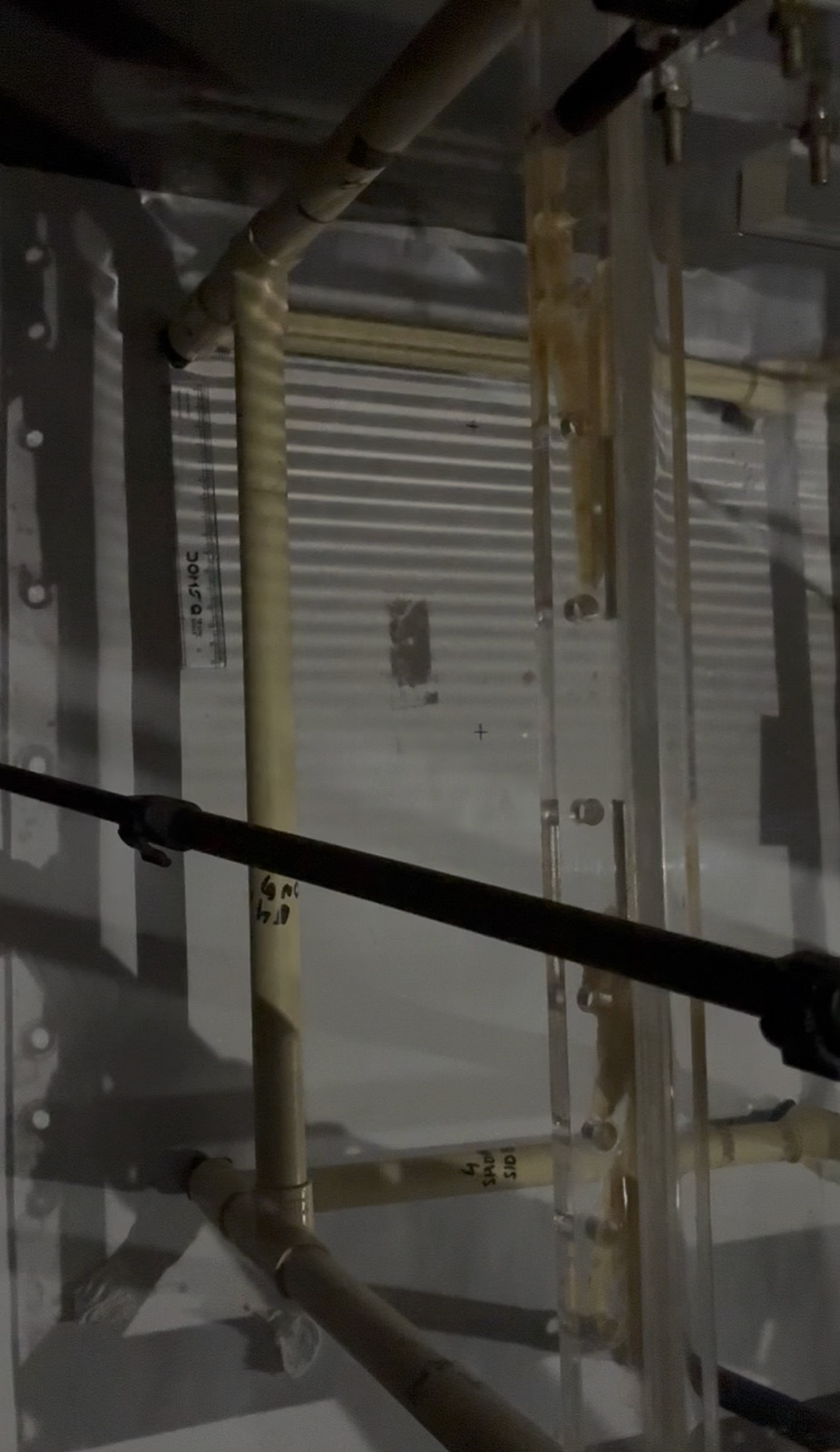 The Ripple Tank Experiment