Day 7 of ICTS-SSWP '26: Statistical Mechanics, Stochastic Modeling, and Structural Coloration
After a much-needed one-day break to recharge, we returned for Day 7 of the ICTS-SSWP 20261. Dr. P. K. Mohanty from IISER Kolkata delivered an incredibly engaging series of lectures mainly focused around statistical mechanics.
We began our discussion by looking at the vast scale of the universe and reminding ourselves that the laws of physics are based on observations of the world around us. From there, we discussed the foundational elements required to model any complex physical phenomenon, which led us into the principles of stochastic modeling. We also discussed why the Three-Body Problem is unsolvable. Using the concept of degrees of freedom, we saw that the system has more degrees of freedom than conserved quantities, making it impossible to find a complete analytical solution.
Then, we turned to a fundamental question: What actually is temperature? We connected the answer to Boltzmann’s statistical framework and used it to derive Einstein’s equation for Brownian motion.
In the afternoon, we had a chance to explore this theoretical framework through a hands-on lab experiment. We constructed a mechanical equivalent of Brownian motion using a tray filled with tiny mustard seeds as the fluid medium and a larger tapioca seed as the particle being tracked. Since the mustard seeds do not possess microscopic thermal energy, we used an amplifier to provide macroscopic mechanical energy that simulated thermal motion. The amplifier fed a Gaussian noise signal into the setup. We used a Gaussian signal because, according to the Central Limit Theorem, the combined effect of many independent random forces naturally produces a normal distribution, which resembles real-world randomness.
Later in the evening, Ms. Akshara an alumna of APU gave an inspiring talk on how undergraduate students can actively contribute to physics research. She shared her academic journey and described how she was able to participate in meaningful scientific research during her BSc.
Her undergraduate project focused on the optical phenomenon responsible for the iridescent blue-green colors seen in certain parts of peacock feathers. Her research aimed to quantify the precise ratio of blue and green light reflected from these regions of the feather.
We gathered good insights hearing about her experiences - from overcoming the challenges of undergraduate research to transitioning into her Master’s program. It reinforced the idea that physics is not just a collection of theories but an active and accessible field of discovery. It also reminded us that many of the phenomena we observe around us can be understood through simple physical principles.
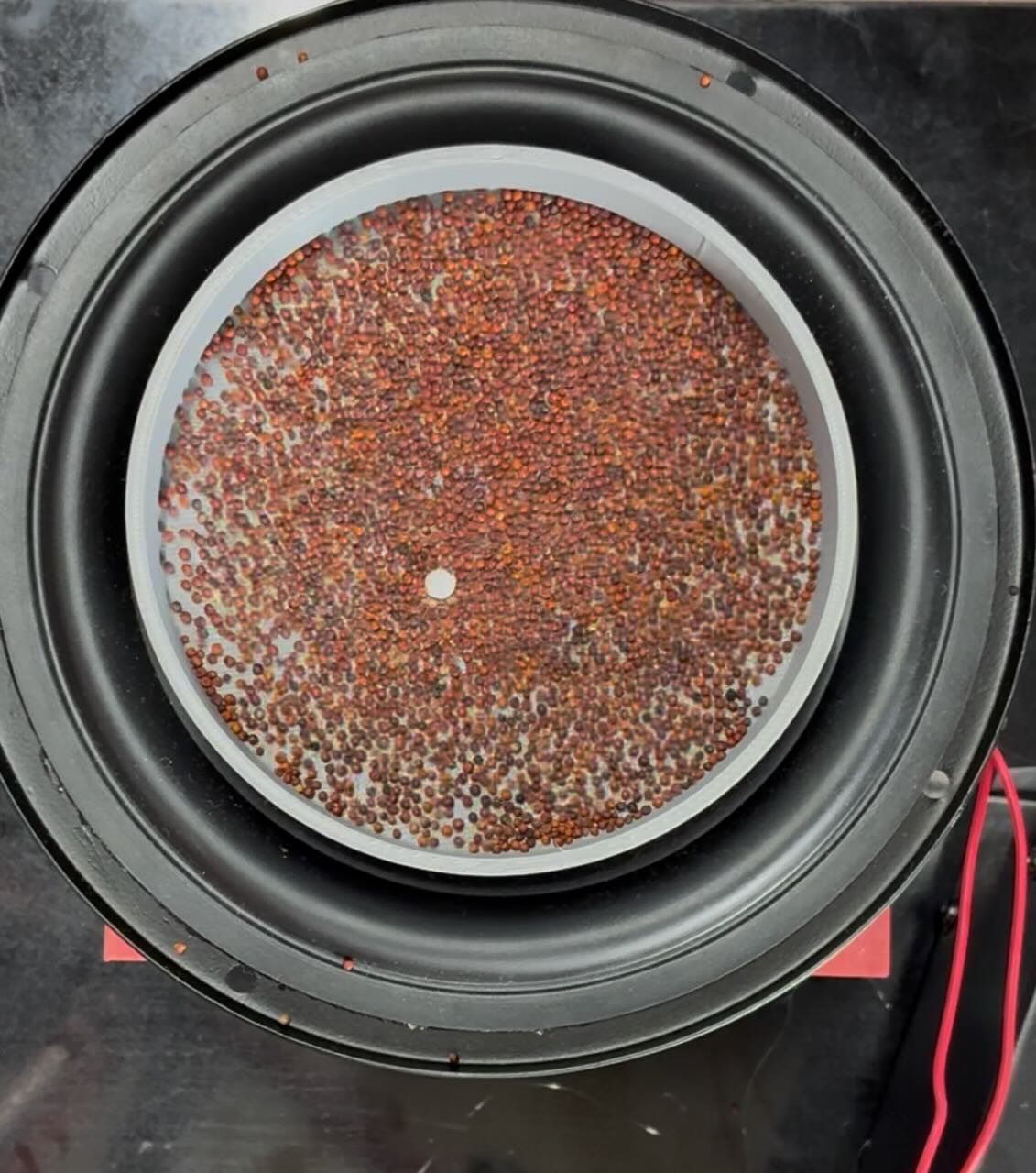
Mechanical Simulation of Brownian Motion