Day 9 of ICTS-SSWP '26: Waves and Ghost Particles
Our ninth day at the ICTS-SSWP 20261 was a blend of mathematical intuition, hands-on lab work, and detailed discussions on both quantum particles and statistical mechanics.
We began the morning with an engaging session titled “Guess the Solution”, led by Prof. Disha Bhatia from APU. The session started with a discussion on the differential equations commonly encountered in physics. We then explored how solutions can often be understood visually by examining the geometric relationship between a curve and its tangents. Rather than solving equations directly, we focused on developing intuition for their behavior through graphs.
During the final lab session of the program, we explored chaos through a double pendulum and a magnetic pendulum. By letting a pendulum swing over four magnets, we saw how a completely deterministic system governed by simple Newtonian laws can become unpredictable. A microscopic change in the pendulum’s release point completely altered its final destination.
We also performed an experiment to calculate the viscosity of a fluid using a Teflon ball. By dropping the ball into the fluid and tracking its motion with the Tracker app, we plotted a velocity - time graph. From this, we determined the terminal velocity and used it to calculate the viscosity of the medium.
Later in the evening, many showcased their talents during an open mic event. It was amazing to see the wide range of skills within the group, extending far beyond physics - including, beautiful artwork and paintings, singing and dancing, shayari, etc.
After this refreshing session, we gathered for a stargazing session. Although cloudy weather limited our observations, we were still able to observe Jupiter along with four of its moons. We also identified the Big Dipper, part of the constellation Ursa Major, and learned about the famous stellar pair Mizar and Alcor, observing them under a telescope. While they appear as two stars to the naked eye, closer observations reveal that Alcor is itself a binary system and Mizar is a quadruple star system.
Despite the brief observing window, the stargazing session was a memorable one - reminding us how much of the universe can be explored simply by looking up!
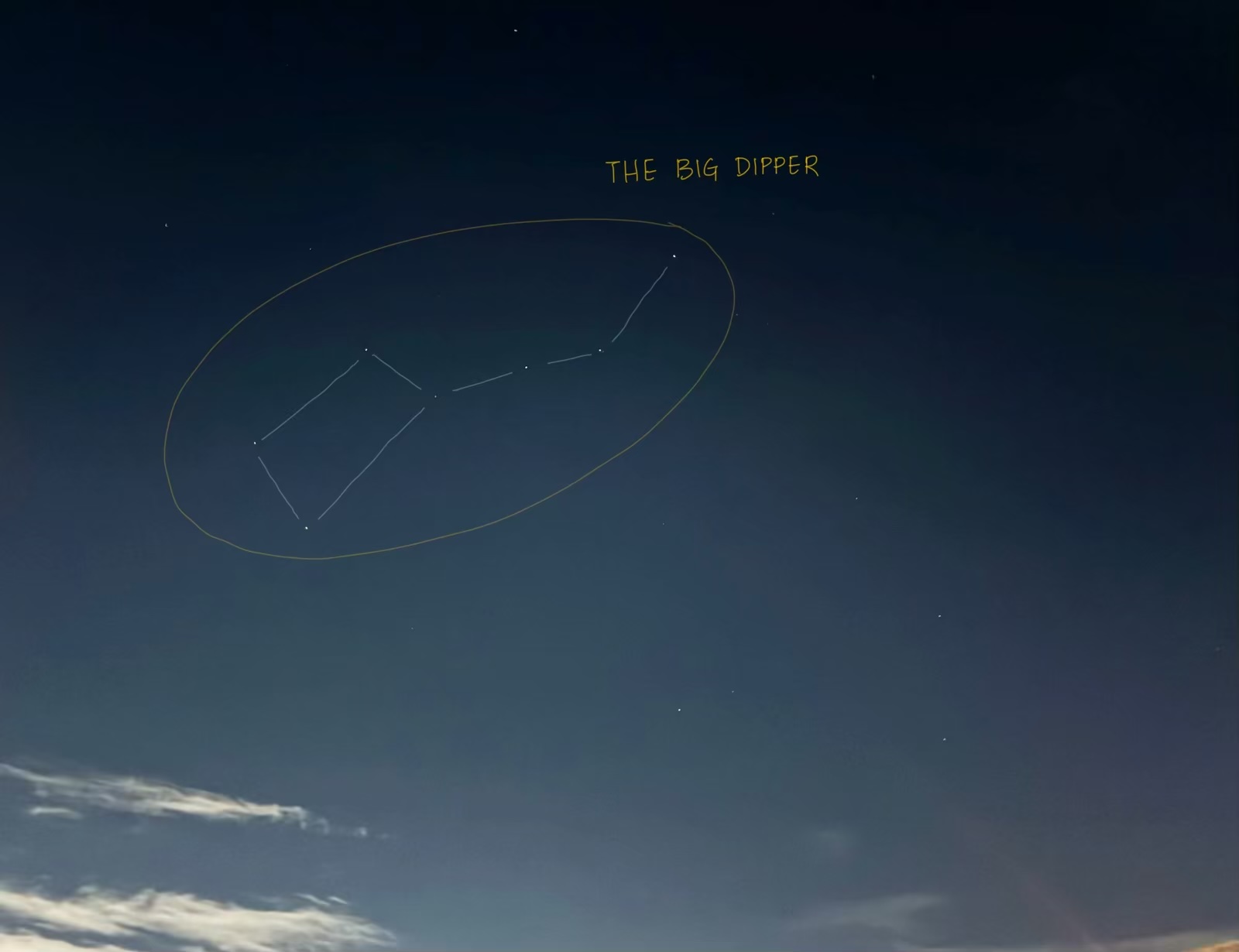 The Big Dipper. This phone photo doesn’t do justice to how incredible it looked through the telescope that night!