Exploring Chaos
Imagine an ideal simple pendulum, an ideal string with a hanging mass. Given its starting position (angle) and velocity we can predict its exact position at any given time using Newton’s Laws.
Now, let us make this problem a little more interesting. Let’s add another string and mass below current mass. Now what do we expect to happen?
Well, we can use Newton’s Laws and write the force equations as before. But when we do so, we find that these equations are highly coupled. The motion of the top arm influences the bottom, and the pull and momentum of the bottom arm feeds back into the top in a continuous loop.
But, unlike a double pendulum, an ideal (undriven) simple pendulum never exhibits chaos, no matter how large its initial release angle is. The explanation is simple - the number of degrees of freedom. More on how degrees of freedom, phase space, 4D trajectories, etc. drive chaos in later blog. For now, let’s explore how this unpredictability unfolds in action.
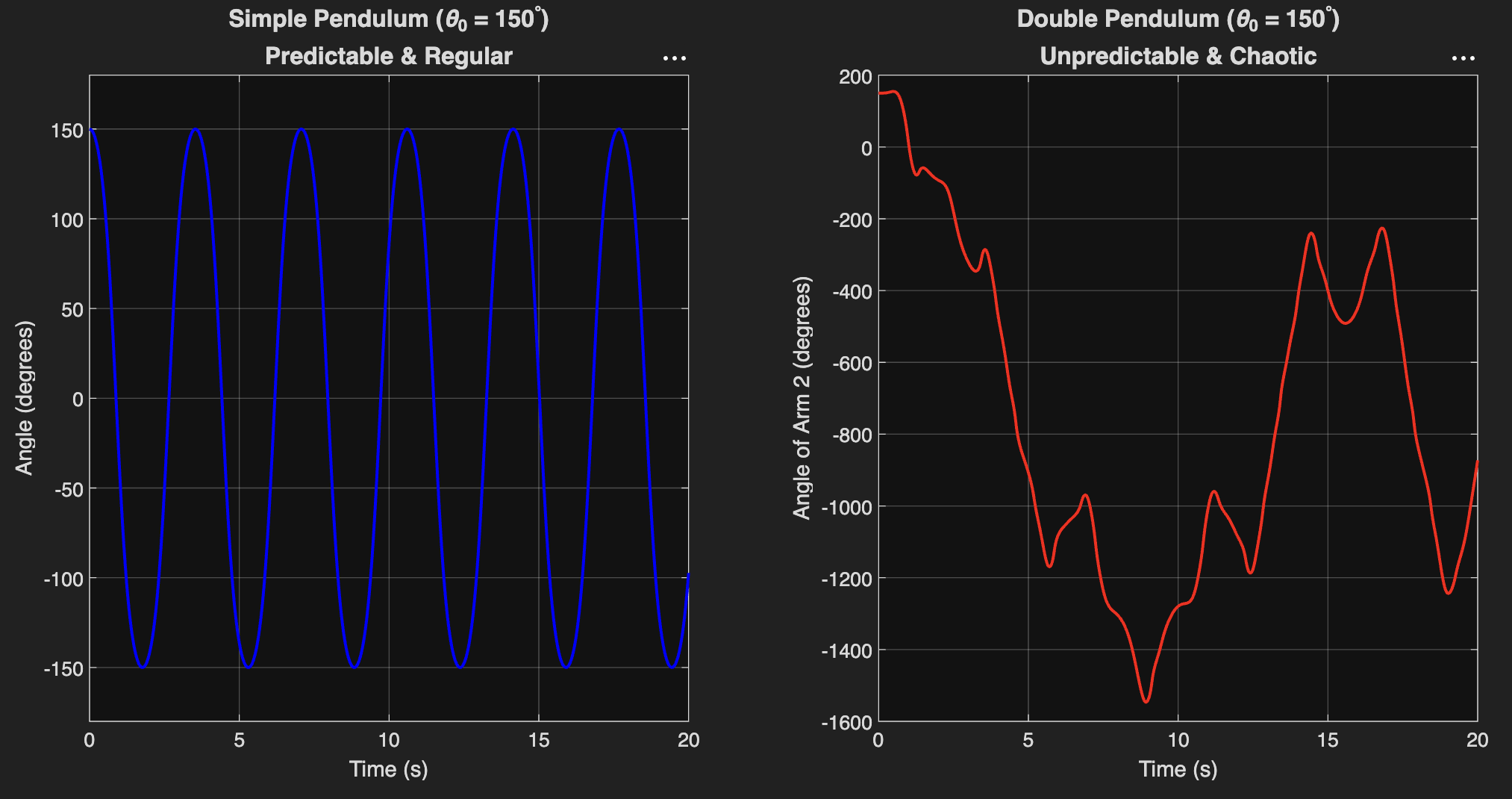
Now imagine releasing a simple pendulum and a double pendulum at the same time. We notice something really interesting: unlike the simple pendulum, the motion of the double pendulum becomes completely unpredictable over a long periods of time as seen in Fig 1.
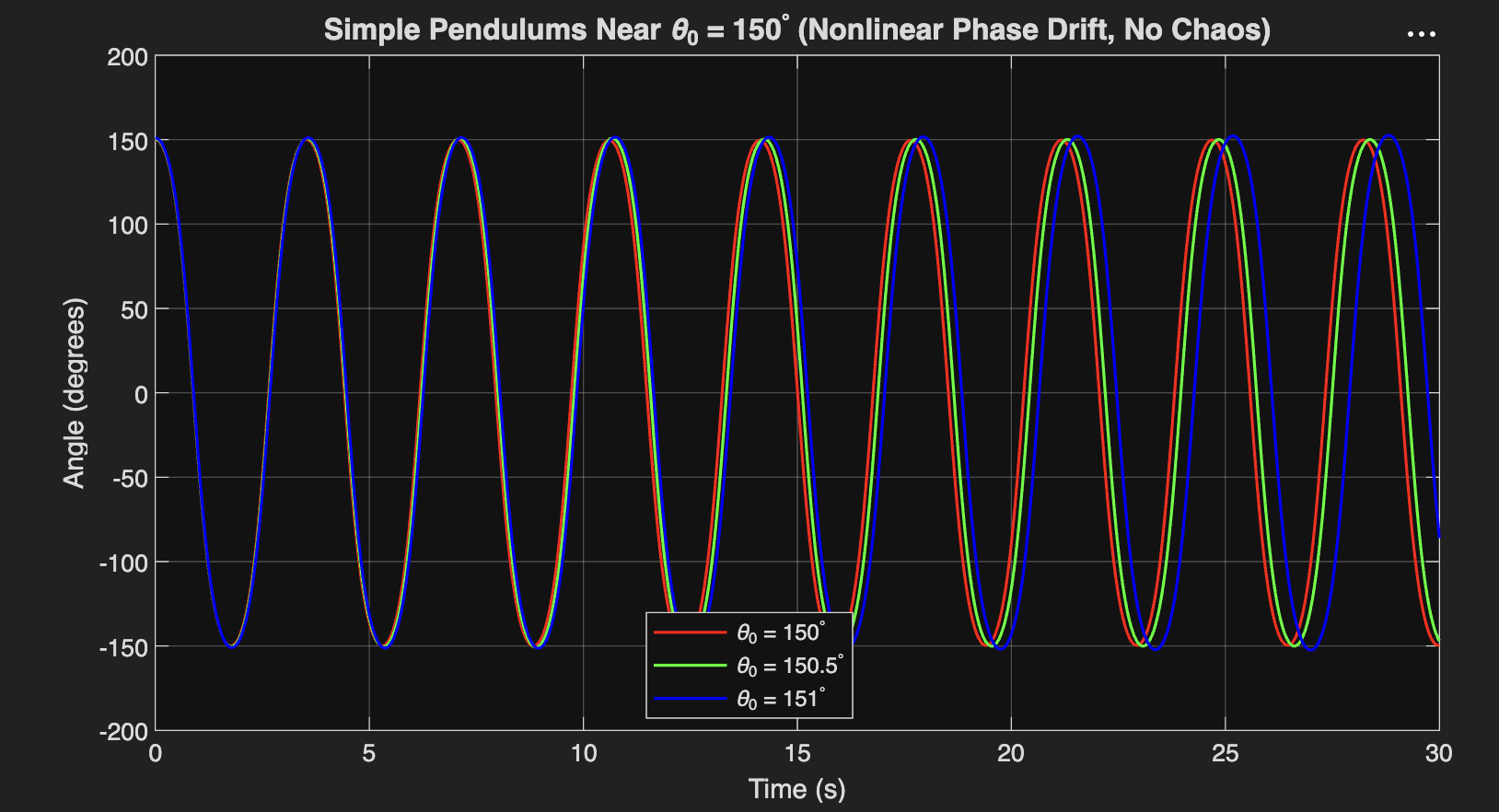
Lets do another thought experiment, we release three simple pendulums, one with an initial angle of $150 ^\circ$ and the other two with a successive difference of $0.5 ^\circ$ each. The result of this is seen in Fig 2, The path of all three remain the same, except with a phase shift.
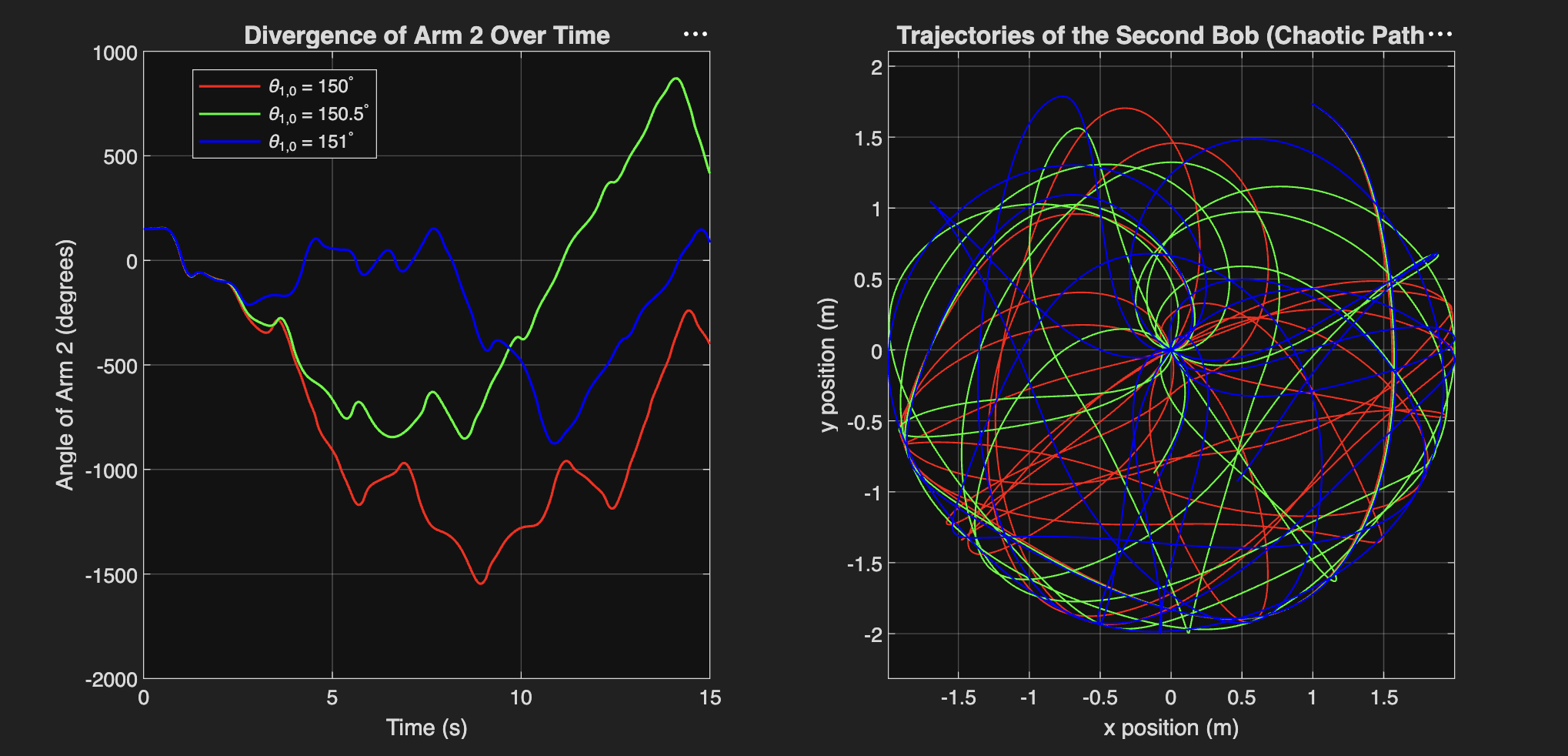
Now, lets do the same with three double pendulums, one of which is released from a large angle, and the other two have a successive difference of $0.5 ^\circ$ each. In this case, for a very short interval of time the three move together before becoming highly chaotic as seen in Fig 3.
But why does this happen? For small angular displacements the equations of double pendulum can be simplified using the small angle approximation - which makes them linear. But approximation breaks down for larger angles making the the equations non-linear/introducing non linear terms.
This non-linearity also means that small changes in our initial conditions no longer produce small proportional differences later - instead, they make the paths radically different within a small time interval.
This is chaos. It doesn’t mean randomness or that physical equations are breaking down. A chaotic system is governed by deterministic mathematical laws, but it remains unpredictable far into the future. This happens because of how these systems are extremely sensitive to the starting conditions. This is called the Butterfly Effect, where a tiny microscopic nudge at the beginning grows exponentially over time, completely altering the system’s trajectory.
But, we might think that if a chaotic system strictly follows the mathematical equations which describe it why should it be unpredictable at all? In fact, the famous thought experiment - the Laplace’s Demon - argues that we can solve any kind of equation. There are two primary reasons why it doesn’t work in practice:
- The system is highly sensitive to initial conditions, meaning, we need to know the starting conditions with infinite precision to be able to predict its motion long into the future. And this is challenging.
- If we could ever find a way to do that, then to calculate its position with that kind of accuracy requires a different kind of computing power. This is because very tiny numerical rounding errors quickly compound and skew the results away from reality.